Stories and Games
Are you looking for a positive alternative to screens?

Hi! I'm Wilf Pauls the Non-digital Games and Story Guy. Check out my children's stories and traditional games.
About Me
Wilf Pauls is a non-digital games enthusiast and author dedicated to creating captivating stories for children. With a passion for traditional games, storytelling, and fostering imagination, Wilf brings a unique blend of creativity and entertainment to his projects. Explore the site to discover the exciting world of non-digital games and storytelling.
School Visits: Storytelling and Games
Recent Visits
Belgo Elementary; Spring Valley Middle School; Rutland Middle; Rutland Secondary; Pearson Road Elem; Marjok Elem; Chief Tomat Elem; Ellison Elem; Highland Park Elem in Armstrong; MVBeattie Elem in Enderby; King's in Salmon Arm.
Past Visits - (pre-2025)
Peter Greer Elem; Black Mountain Elem; Rutland Elem; South Kelowna Elem; Canyon Falls Middle;
Most Schools in SD#83 before we moved to Kelowna: South Canoe; Highland Park; Armstrong Elem; Sorrento; MVBeattie; Hillcrest; South Broadview; Shuswap Middle School; Parkview Elem in Sicamous; Silver Creek; North Canoe; Bastion Elem.
Seven Elementary Schools in Delta
Private Schools
Pleasant Valley in Vernon; King's in Salmon Arm; Kamloops Christian;
Cornerstone and MEI in Abbotsford
Children's Books
Wilf Pauls has encouraged thousands of children in their love of learning through stories, magic, science experiments, music, trivia, and real-life experiences. He has published four children's books: Baby Brawn Hockey Superstar, Baby Brawn Basketball Superstar, Fweddy the Wed Fwog Pwince, and The Baseball Bat (A True Story). Cathy Steeves was the Illustrator for the Baby Brawn books while Myron Born illustrated Fweddy the Wed Fwog Pwince.
Cost per book is $15 plus shipping. See contact info below.
Author Visits
A typical author visit:
Baby Brawn Hockey Superstar – I start off telling fascinating hockey stories/trivia, this leads to the writing process, we play table hockey (I bring up to 8 games) and then I introduce and read the book at the end. (I bring my own projector/screen). Group Size: 30 Time: 45 minutes Space: seating/ 3 long tables, projector/screen
Endorsed by Hailey Wickenheiser!
Baby Brawn Basketball Superstar – I use the history of basketball as a basis for the writing process and the development of this basketball story. As we talk about the evolution of the game and the types of shots, students have the opportunity to shoot hoops at my two mini 6’ basketball hoops plus an apple box and a basket which are set up on ladders. Then I give more details of my story and read the book on the big screen at the end.
Group Size: 32-36 Time: 50-55 minutes Space: seating/4 hoops, projector/screen
Fweddy the Wed Fwog Pwince – We play with words and I tell stories about people who have trouble saying certain letters. This leads to a chat about bullying with more true oral stories. We even sing a few tunes, purposely twisting the words. I introduce the story and then read it on the big screen.
Group Size: 60 Time: 45 minutes Space: seating for group, projector/screen
The Baseball Bat (A True Story) - I do a short bio of places we’ve lived. This leads to several entertaining, attention grabbing true stories about honesty, stealing and consequences. Baseball vocab and stories are in the mix. I share the writing process and particular details of this story before I read it on the big screen. If time allows, I have follow-up questions from the back of the book.
Group Size: 60-125 Time: 45 minutes Space: seating for group, projector/screen


The Games Project

The Games Project introduces four traditional non-digital games: Sjoelbak (Holland), Crokinole (Southern Ontario), Table Hockey (Canada) and Pitchnut (Quebec; a variation of Carom from India). This can involve up to 64 students/adults, if you have space (gym or large room) for 4 Pitchnut Games, 4 Crokinole Boards, 6-8 Table Hockey Games and 6 Sjoelbak Games.
This is a hands-on session involving all students and adults as participants. It works best from grade three and up. A typical session is as follows:
A. I introduce each game and throw in some of its history.
B. All students play all four games for 6–10 minutes each. We divide them into groups of four and they rotate to each station.
C. We bring the big group together and I read a true story called “The Crokinole Kid” which involves my grandson participating in the BC Crokinole Championships with me in 2019 when he was in Grade 6.
It works best when we have 70-75 minutes/session. This is adjustable…I’ve done one-hour sessions where we shorten things up. I bring my own screen/projector plus 10 tables. You need 32 chairs & a few more long tables.
These are the Games I bring to your school.
Table Hockey Sjoelbak Crokinole Pitchnut
Rules for the Games: I adapt games for children. The point is to have them succeed within reason. I want them to learn the game and sometimes give extra chances.
The most challenging skill to learn is how to 'flick' the shooter with minimal pain. It's a good idea to demonstrate how to put your fingernail very close to the shooter. Practise before playing a game. I also try to emphasize 'kindness' - we are all learning and cheering each other on!
Extra Note: With Pitchnut and Crokinole make a point of telling students to keep their arms and hands and yes, their whole bodies OFF the table and game! Middle School slouchers love to lean on anything, it seems! Make this a fun part of your introduction!
Crokinole Rules - See the World Crokinole Championships website : https://worldcrokinole.com/thegame.html
Sjoelbak Rules - See the Masters Traditional Games website:
https://www.mastersofgames.com/rules/sjoelbak-rules.htm
Table Hockey Rules: Check the International Rules website:
https://tablehockeypro.com/pdfs/International_Table_Hockey_Rules.pdf
Pitchnut Rules
These rules are my interpretation of the game for a stationary board. They differ from the Carom Board Game.
Goal: To sink all of your pieces and the "poison” before your opponent does.
Players: 2-4, sitting across from one another. In doubles, you sit across from your partner. Play moves clockwise.
Game Play: Play begins with alternating black and white pieces (12 of each) in a ring, in the center of the board. The odd colored piece (poison) is placed in the center of the board.
Select someone to make the break.
The shooter is usually flicked with the index (or middle) finger and thumb in a flicking action ("pichenotte" in French). To reduce pain and suffering, keep your index (or middle) finger as close to the shooter as possible. The shooter may be flicked without the use of the thumb (Indian style), but your finger cannot make contact with the shooter after it passes the line. You must shoot the shooter touching your own "end zone line" The pieces must be struck with the shooter.
Shooting backwards: With children, if one of your pieces is behind your shooting line, I let them simply shoot backwards as long as their shooter is touching the line or another piece that is touching the line. With adults you may only shoot backwards if another piece of any colour is touching your line…then you may place your shooter against that piece and shoot backwards.
If one of your own pieces is touching your line, you may shoot it backwards.
If the poison is sunk on the break, the breaker wins- as long as the poison goes in alone. If the breaker scratches or sinks an additional piece, they lose.
You may "play off" your opponent's pieces. You may also play off your opponent's pieces when shooting the "poison" at the end of the game. You do not need to call your shots. If the shooter is pocketed or is launched off the board it is considered a scratch- one of the scratcher's pieces is removed from a pocket and placed in the center of the board, and their turn ends. If your opponent returns a piece to the center of the board and you are unhappy with the placement, you may adjust it before, but not after the subsequent turn.
If a piece is already at the center of the board, the scratched piece is placed on top of the one in the center. Several pieces may be stacked in the center of the board. If the stack falls over, it must be left where it falls. [I DON’T PLAY THIS RULE. I JUST PLACE THE PIECE IN THE CENTER CIRCLE.]
If a player scratches and they have not yet sunk any pieces, they "owe": the first piece that they sink on a subsequent turn must be placed back in the center and their turn ends. [I DON’T PLAY THIS RULE WITH KIDS!!]
If you sink your piece and your opponent's piece (regardless of the order they are hit) on the same shot, they cancel each other out and you lose your turn. The pieces stay in the pocket.
After sinking a piece, you receive another turn. If you sink two pieces on the same shot, you receive two extra turns. If get a triple, you receive three extra turns. If you get a double and on the next turn get another double, you receive three extra turns (why three? because you took a turn to get the second double.) [I ONLY LEARNED THIS RULE RECENTLY!]
The Pitchnut board stays stationary during a game.
Winning the Game: To win the game, you must sink the poison after pocketing all your pieces. If the poison is sunk before all your pieces are sunk, you lose – The Game is over!! The poison must be sunk by itself! If you get another piece in on the same turn (or scratch), you lose. If you scratch while shooting the poison, but the poison is NOT sunk, you do NOT lose- one of your pieces is placed in the center.
What Ifs...
• If you sink your own piece and your opponent's piece on the same shot and scratch, your piece is placed in the center of the board, but your opponent's piece stays in the pocket. Your turn ends.
• If you sink a piece of each color on the same turn, your turn ends, even if it is the beginning of the game and the players' colors are not set.
• If you sink two pieces of one color and one of another and scratch before the colors have been set, your color is the color of the two pieces you sunk. You then return one to the center and your turn ends.
• If a piece or shooter flies off the board, the player responsible for sending it off is responsible for chasing it down and returning it.
• If a player accidentally (or intentionally) moves a piece, they must be returned, as close as they can, to their original positions.
• If a piece lands on the top of a board's side it is considered out of play and is returned to the center circle. If the shooter lands on top of a board's side it is considered still in play.
• If you get a double and one opponent's piece, your turn ends.
• If you get a double and scratch on the same shot (or on the next shot), your turn is over.
• If a piece of each color flies off the board, both are returned to the center of the board. Your turn is over.
Kid's Rules (or adults who struggle mightily): It is advisable for beginners to learn Pitchnut while playing doubles.


The Africa Project
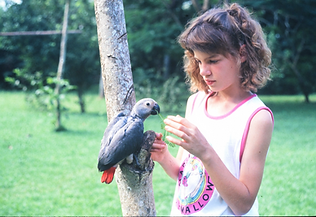
I've put together a series of true stories/experiences from Africa which will keep your classes wide awake and entertained with a combination of laughter, intensity, warmth and wonderful lessons learned.
These stories cover the range of:
a. living in another, very different culture
b. snake stories
c. stealing episodes
d. tarantulas in science class
e. bartering and African money
f. how a leper named Toza showed us an unforgettable example of gratefulness.
Audience size can be fairly large - 100 + although smaller is always cozier.
Age Range: Gr. 3 - Adult
Time: about 45 - 60 minutes. 3 sessions/day.




HIGHLIGHTS
Recipient of hundreds of pictures and 'thank you' notes from grateful students and teachers.
BC 55+ Games:
Table Tennis Competitive Singles, Doubles and Mixed Doubles Gold.
BC Crokinole Championships:
Recreational Singles Gold
Recreational Doubles Silver
PERSONAL PASSIONS
Traditional Games
Storytelling Experiences
Physical Fitness
Community Engagement
Volunteering
Table Tennis
Grandchildren